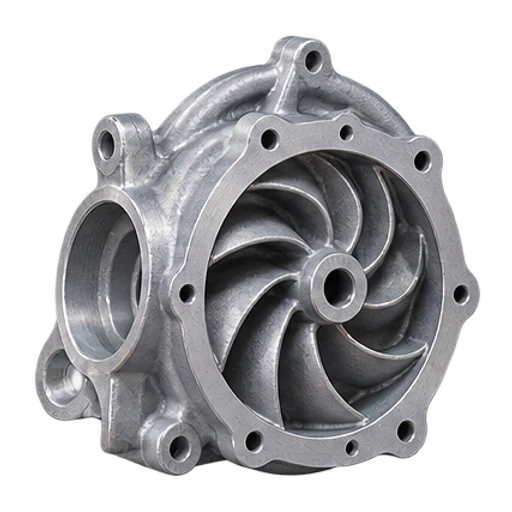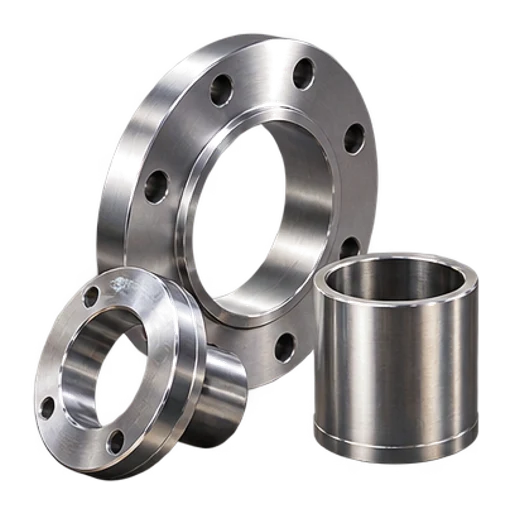
Stainless Steel Castings
Stainless Steel
Corrosion and heat resistance — and the decisive difference between cast and wrought
Specialist foundry — Industrial Zone, Abu Zaabal, Qalyubia, Egypt
An essential distinction: the well-known numbers customers ask for belong to wrought stainless steel. The cast equivalent has an entirely different designation beginning with CF or CK.
The most important thing to understand here is that the number a customer asks for is a wrought stainless designation. A foundry does not cast that designation literally; it casts the cast equivalent from the CF family, which is designed to give the same performance with a composition adapted to casting. A request for the chloride-resistant grade is executed with its molybdenum-bearing equivalent. This is not a substitution trick — it is what the international standards specify. As a specialised stainless foundry, we cast the standard cast equivalents of the grades requested in our customers' drawings.
Cast equivalents of the well-known grades
| Grade | Designation | Tensile N/mm² | Yield N/mm² | Elongation % | Hardness HB | Structure |
|---|---|---|---|---|---|---|
304 The general-purpose grade — no molybdenum | CF8 (ASTM A351) | — | — | — | — | Austenitic |
316 Higher pitting resistance — chloride environments | CF8M (ASTM A351) | — | — | — | — | Austenitic + Mo |
310 High temperature resistance | CK20 (ASTM A351) | — | — | — | — | Austenitic, high Cr/Ni |
The practical difference between the general grade and the molybdenum grade is the molybdenum itself. Do not pay the price premium for the molybdenum grade unless the environment contains chlorides (sea water, chemicals, salts) — in ordinary environments the general grade serves the same purpose. The heat-resistant grade is for high temperature, not chemical corrosion.
Chemical composition
Composition is binding in the standard, because it is the source of the corrosion resistance itself (the protective chromium oxide layer). The letter M in the cast equivalent designation denotes molybdenum, and the rest of the designation refers to the nickel content.
Advantages
- •Excellent corrosion resistance
- •Good performance at high temperature (especially the heat-resistant grade)
- •Hygienic surface suitable for food and pharmaceutical use
- •Long service life without coating
Limitations and considerations
- •Significantly higher cost
- •The general grade is not sufficient in chloride-rich environments
- •Requires careful casting practice to avoid defects
Common applications
Sectors
International equivalents
Data sources and scope
The values above are taken from standard ASTM A351 / A743 (cast) — EN 10088 (wrought) and represent the reference standard limits. The actual properties of any delivery are established by the foundry's analysis and test certificate for that specific heat, and are affected by section thickness, casting conditions and heat treatment. Final material approval for any application is subject to a joint technical review with our engineering team.
Need a casting in Stainless Steel?
Send your drawing or sample — our technical team will review it and recommend the most suitable grade.