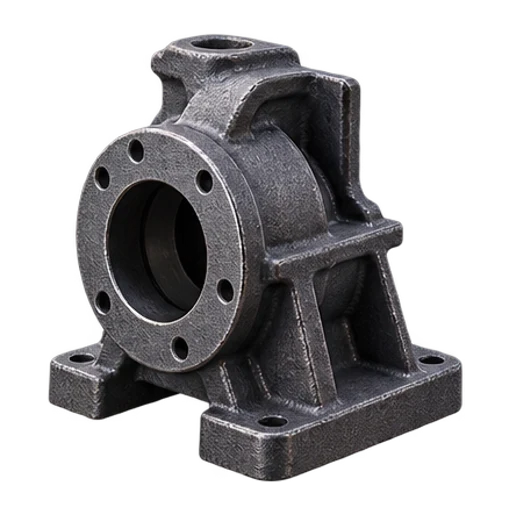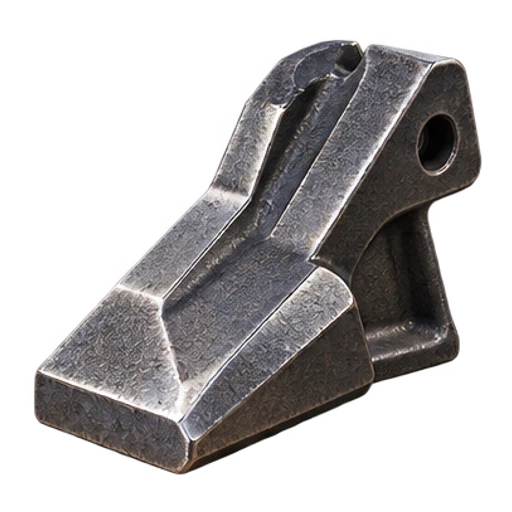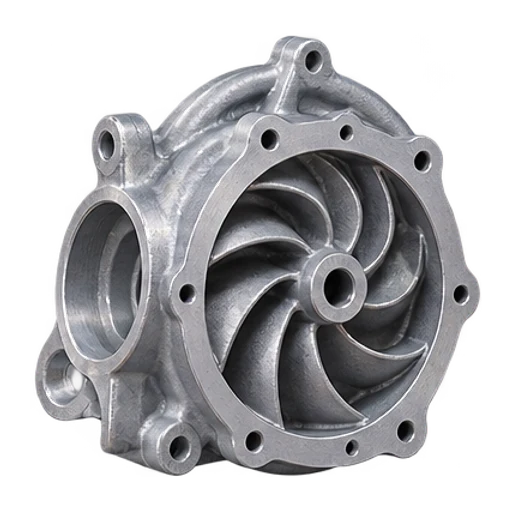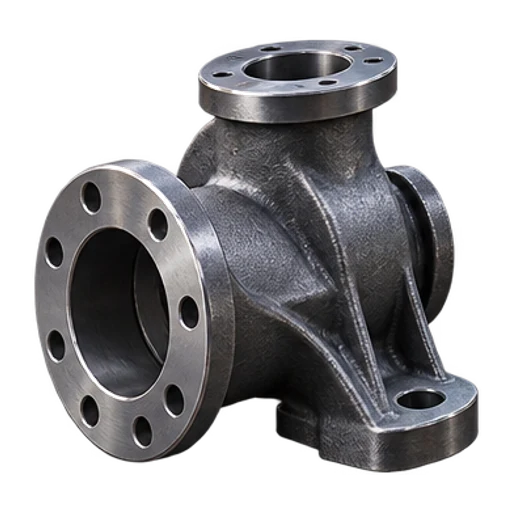
Ductile / Spheroidal Graphite Cast Iron Castings
Ductile / Spheroidal Graphite Cast Iron
The best balance of strength and ductility in the cast iron family
Specialist foundry — Industrial Zone, Abu Zaabal, Qalyubia, Egypt
The European standard for spheroidal graphite cast iron (replacing the withdrawn German DIN standard). The older GGG designations remain in commercial use and correspond to the modern EN-GJS designations.
Ductile iron differs from grey iron in one decisive way: the graphite inside it forms as tiny spheres instead of flakes, achieved by adding magnesium during pouring. That structural difference alone is the reason for its jump in ductility and impact resistance — because graphite flakes in grey iron act as stress concentration points where cracks begin. As a specialised ductile iron foundry, we cast all four standard grades to your drawing or sample.
Ductile iron grades to EN 1563
| Grade | Designation | Tensile N/mm² | Yield N/mm² | Elongation % | Hardness HB | Structure |
|---|---|---|---|---|---|---|
GGG40 Highest ductility and impact resistance | EN-GJS-400-15 | — | — | — | — | Ferritic |
GGG50 Most common — a practical balance | EN-GJS-500-7 | — | — | — | — | Ferritic / pearlitic (≈50/50) |
GGG60 For higher loads and better wear resistance | EN-GJS-600-3 | — | — | — | — | Pearlitic / ferritic |
GGG70 Highest strength and hardness, lowest ductility | EN-GJS-700-2 | — | — | — | — | Mostly pearlitic |
Read the standard designation directly: EN-GJS-400-15 means 400 = minimum tensile strength in MPa, and 15 = minimum elongation as a percentage. Any grade higher in strength necessarily means lower elongation — no grade combines the maximum of both. The right grade for your part is settled in the technical review.
Chemical composition
International standards state explicitly that the chemical composition of ductile iron is indicative and is not used as a quality acceptance criterion. The binding acceptance criterion is the mechanical properties in the table above, proven by a tensile test certificate for each heat.
Advantages
- •Far higher ductility and impact resistance than grey iron
- •Excellent machinability
- •Lower cost than cast steel at comparable strength
- •Complex shapes cast accurately
Limitations and considerations
- •Lower vibration damping than grey iron
- •Requires precise magnesium control — deviation loses the properties
- •Higher grades lose a large part of their ductility
Common applications
Sectors
International equivalents
Data sources and scope
The values above are taken from standard EN 1563 and represent the reference standard limits. The actual properties of any delivery are established by the foundry's analysis and test certificate for that specific heat, and are affected by section thickness, casting conditions and heat treatment. Final material approval for any application is subject to a joint technical review with our engineering team.
Need a casting in Ductile / Spheroidal Graphite Cast Iron?
Send your drawing or sample — our technical team will review it and recommend the most suitable grade.